
Bitcoin (BTC) is going through a particular moment. And the miners are showing a level of inactivity in terms of sales that was not frequently seen in previous cycles.
At the time of publishing this article, March 24, 2026, the Miners Position Index (MPI) is around -1.04, one of the lowest values from 2016 to 2026. Furthermore, it is only the third time within the aforementioned period that its 30-day moving average has approached the -1 threshold.
“These depressed MPI levels indicate that miners are sending significantly fewer coins than usual relative to their annual average,” explained Ignacio Moreno de Vicente, specialist at the on-chain data analysis platform CryptoQuant.
This indicator measures the relationship between the amount of bitcoin that miners send to the market and its annual average. To put it more directly, compare how much they are selling today versus what they typically sell over a one-year period.
For example, if on average miners send 1,000 BTC daily and are currently only sending 400, the indicator will reflect a significant drop in selling pressure.
When the MPI falls to extreme negative values, as it does today, It means that miners are selling much less than usual.
“In other words, miners’ selling pressure is structurally low, suggesting they are stockpiling rewards or anticipating higher prices, or both,” the analyst added.
The graph allows us to better understand the historical behavior of this indicator and its relationship with the price of bitcoin.
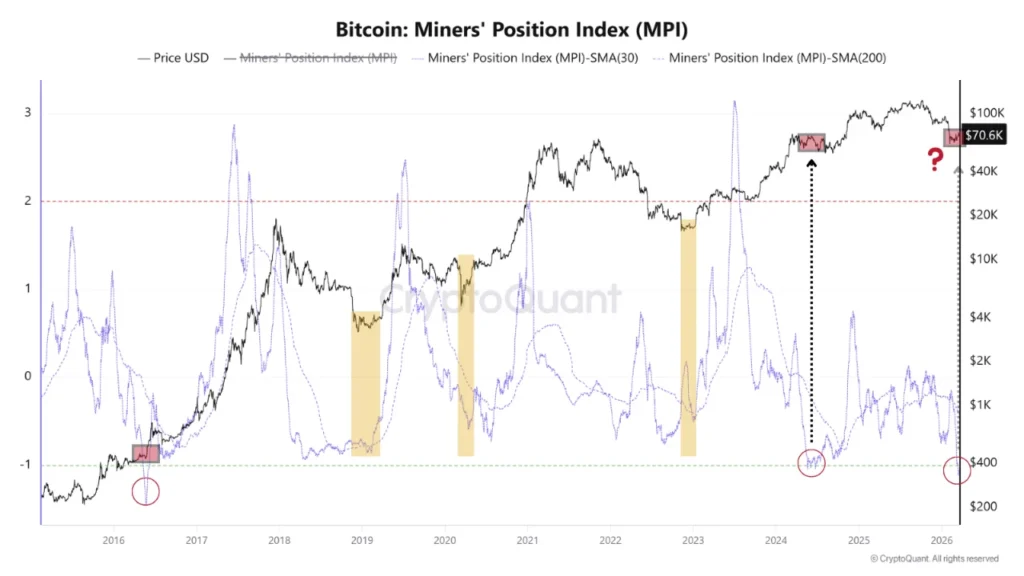
As seen, the black line represents the price of BTC, while the blue lines correspond to the MPI: one shows the daily value of the indicator and the others its 30- and 200-day moving averages, which help smooth out volatility.
For their part, the red circles indicate moments in which the indicator reaches extreme negative levels, close to or below -1. These points coincide with episodes of stress in the mining sector or stages following capitulation events.
If you look at previous episodes in which the MPI fell to levels close to or below -1, you see that BTC was going through areas of weakness or transition, but it did not always touch its exact floor there.
It happened in 2015-2016 and again between late 2022 and early 2023: in both cases, the indicator coincided with mining stress and low selling pressure, while the price recovery came later, when the MPI began to rally. This suggests that there is a relationship with moments of bearish exhaustion, although it does not function as a precise minimum signal.
“Historically, these extreme levels usually appear in times of stress or after phases of mining capitulation, although they do not precisely mark price minimums,” said Moreno de Vicente.
A relevant pattern is that market floors do not usually coincide exactly with these extremes of the MPI. Instead, they tend to form when the indicator begins to recover from those depressed levels. “The absence of sales by miners removes a structural obstacle, but is not enough on its own to drive a price reversal,” the analyst explained.
The historical behavior of Bitcoin miners would be changing
The fact that miners are selling less bitcoin can be interpreted as a positive sign. The fact is that by reducing the supply in the market, one of the constant sales flows that have historically influenced the price is eliminated.
However, the indicator has a key limitation: it does not measure who is buying.
«The MPI captures the relative sales behavior, but it does not show who is absorbing that supply. Without expansion in demand, it cannot sustain an upward movement by itself,» warned Moreno de Vicente.
Added to this scenario is a possible structural change in the sector’s business model. From Xapo Bank, a financial entity focused on bitcoin and digital asset services, they propose that The historical behavior of miners could be changing.
«The old pattern of mining capitulation is no longer relevant. In 2026, miners no longer depend exclusively on the price of BTC to sustain their operations,» they said from the institution created by Argentine technology entrepreneur Wenceslao Casares.
As they explain, part of the sector is diversifying their income towards computing for artificial intelligence (AI), which allows them to reduce the need to sell BTC in times of pressure. «Miners are no longer obliged to sell their reserves to cover costs. They now have an additional source of income, which aligns them more with holders than with forced sellers,» they argued from Xapo Bank.
In that sense, even events such as the hashrate drop last week, close to 15%, can be interpreted differently. «This adjustment is not a withdrawal, but an optimization. Miners are evolving towards diversified data centers,» they maintain.
The current MPI level raises a key question: is it a sign of strength or a silent warning?
On the one hand, low selling pressure from miners is a factor that has historically favored the price of BTC. On the other hand, past behavior shows that this condition, by itself, does not define the beginning of an upward trend.
“The signal becomes more relevant when the MPI begins to recover from these levels, which indicates a reactivation in parallel with better market conditions,” Moreno de Vicente concluded.
For now, the data reflects a market with less structural selling pressure, but still dependent on other factors to define its next direction.