

2026 has begun turbulently in regards to macroeconomic and geopolitical environmentshaking the market on several occasions. Nevertheless, US 10-year bonds have completed their best monthly performance in a year according to Michael MacKenzie, Ye Xie y Mia Glass en Yahoo Finance.
The result: the US 10-year bond yields fell 25 basis points this month (the biggest drop in a year), surpassing the 4% for the first time since November. He Bloomberg Treasury Bond Index recorded a profitability of 1.5% in February, while a long term debt indicator advanced a 4%.
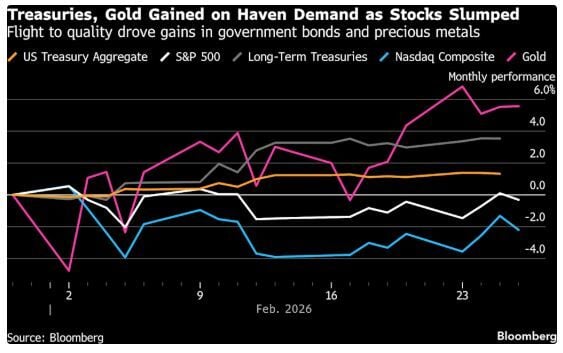
The rally is a reminder that, at least for now, the U.S. government bond market, valued at 30 billion dollarshas an advantage like security optiondespite questions that have arisen about the defensive appeal of American government values under the turbulent policies of President Donald Trump’s second term.
“Without a doubt, US Treasuries will continue to be a safe haven,” he said. James Athey, portfolio manager at Marlborough Investment Management. “The market is too large, liquid and dominant to be completely or easily dismissed as a haven destination for quality investment.”
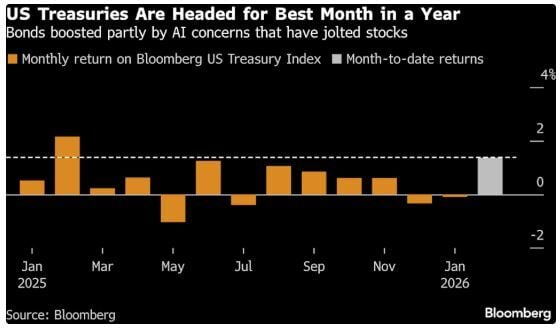
The gains have given positive direction to a market that has traded in a tight range for months amid mixed signals on U.S. employment, growth and inflation. While many investors say a concrete economic catalyst will be needed for Treasuries to move decisively in one direction or another, the haven for quality investing provides a buying base to offset negative pressures.
“There is a safe haven component to the Treasury market,” he said. Gregory Faranello, Head of US Rates Trading and Strategy at AmeriVet Securities. “We could break through these levels, and technically the market is trading quite well, but I don’t see any fundamental reason for rates to go much lower from here.”
Bullish dynamics have driven advances in government bond markets, leading to global sovereign bond index to your fourth consecutive month of profits. The movement has been particularly notable in Japanwhere bonds are on track for their biggest monthly rally since November 2023. Foreign investors are piling into Japanese debt, with their purchases reaching the second-largest amount on record last month.
However, Treasuries remain the main beneficiaries. During the first two months of the year, around 16.3 billion dollarsaccording to EPFR. This contributed to 10-year yields (a benchmark for everything from mortgages to credit cards) falling by about 0.2 percentage points since the end of January.
The movement gained momentum as the constant deployment of new AI tools threatened to disrupt industry after industry and keep pricing power in the broader economy in check, repeatedly sending U.S. stocks tumbling and causing a S&P 500 drop of up to 1.6% in a single session.
He rising tensions in the Middle Eastfueled by Trump’s warnings about negotiations with Iran, has contributed to the unease, as has concern about imminent risks in the private credit marketwhich amounts to 1.8 billion dollars.
«The market is repricing credit risk, making the interest rate risk inherent in investing in Treasury bonds more attractive, especially with underlying inflation trending downward,» he said. Priya Misra, portfolio manager at JPMorgan Investment Management.
Despite this month’s gains, Treasuries have yet to clearly break out of the range they have held in since September. The two-year US bond yields have been negotiated between 3.4% and 3.6%, while the 10 year bond was around the lower limit of 4% until he got over it on Friday morning. George Catrambone, Head of Fixed Income at DWS Americastook a neutral stance on 10-year bonds this week, as this area «has come a long way in a short time» and, at around 4%, «it’s not a bad time to take a breather.» Athey said his team recently changed from neutral to a short position, given its outlook on the path of interest rates this year.
Investors say they need new evidence to steer the market in one direction or another. They could get them next week, with the latest reading of US payrolls. For now, operators practically They see no chance of the FED cutting interest rates in March. The monetary authorities kept financing costs unchanged in a range of 3.5% al – 3.75% in January, and some even raised the possibility of an increase.
Although the rate cuts have been postponed, the market still expects at least two reductions by the end of the year, a period in which it is expected that Kevin Warshchosen by Trump, assumes the presidency of the FED.
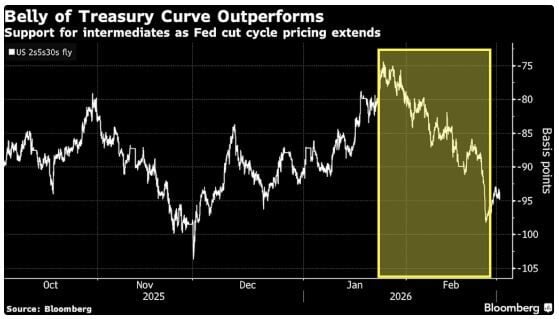
Some point out the recent outperformance of US five-year bonds as a reflection that operators are beginning to discount the risks that the rapid development of AI could disrupt the labor market and reduce consumer prices in the coming years. This speculation also led traders to bet that the FED will continue cutting interest rates next year instead of uploading them. Although positive sentiment prevails, some investors maintain a position underweight Treasury bonds and, with the FED maintaining its stance well into the year, they want to see clear signs of weakness. Then they will know that the rebound is real.
«You would need to see something significant to buy here, and that would come down to the clarity of the economic data showing the labor market is weakening,» he said. Jack McIntyre, gestor de cartera de Brandywine Global Investment Management. “For now, they still view U.S. bonds as rangebound.”