
Although it may seem like a contradiction, it is as if you loved a mansion in the center of Madrid that they gave it to you as a gift. But to be able to access it you have to renovate it for a multi-million dollar amount. Well, we are almost in the same situation. You will still see it as pretty, but you won’t even come close to buying the bargain that really isn’t such.
As we already explained in another article, The intervention in Venezuela does not seem to have been for an oil motive. I don’t know, I’m not in Trump’s head. But of course, Based on the data, it seems very complicated. I insist that we have already done calculations, but I am going to give you new ones to confirm what we have already been saying.
Source: Carlos Arenas Laorga
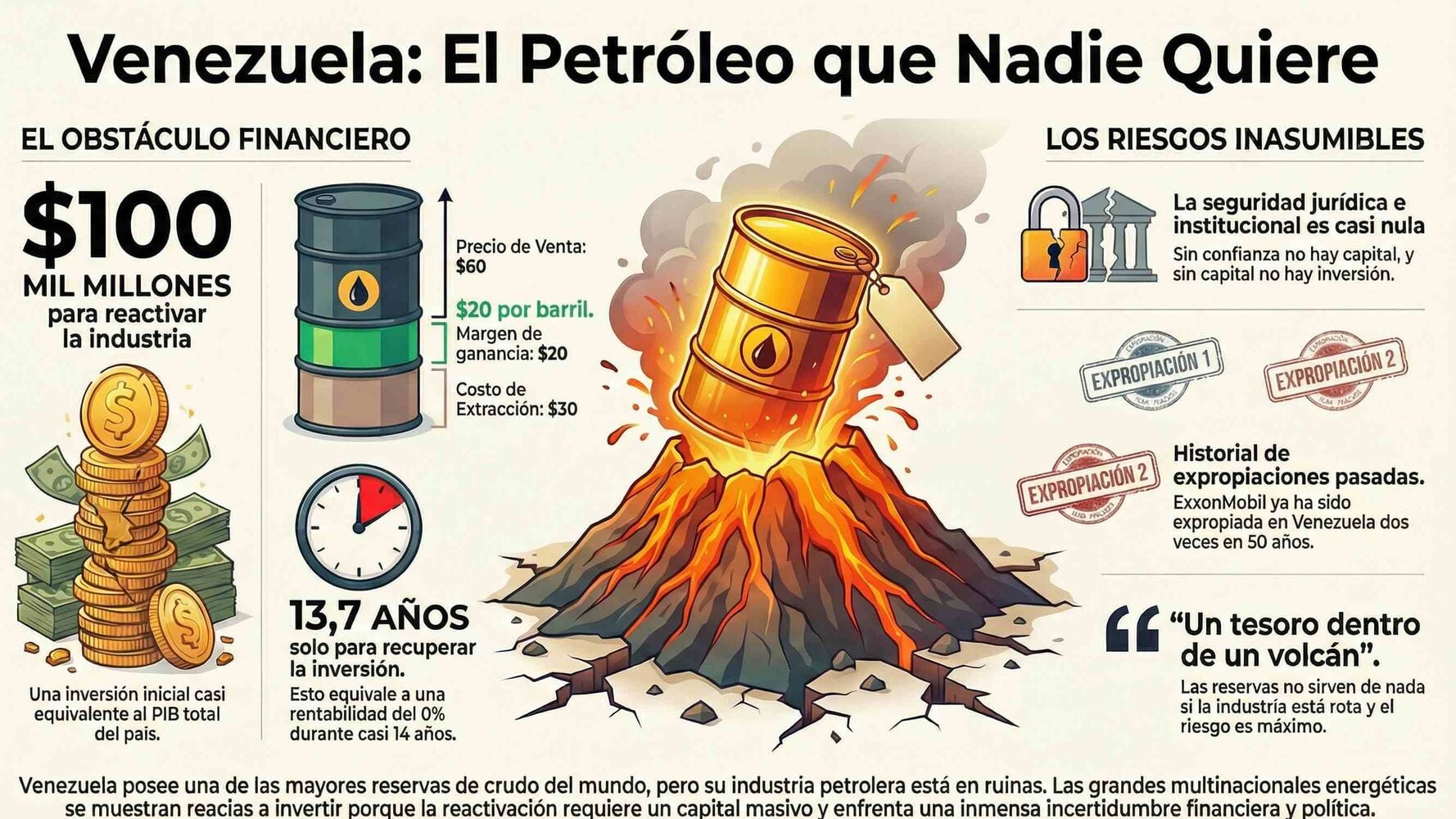
If we see it with figures perhaps it will be more explicit. It is estimated that restart the oil industry Venezuela would require an investment of about 100 billion dollarsalmost the equivalent of its GDP. Not even companies with deep pockets like ExxonMobil or Shell want to enter. And it is logical. Is big money. If the reward were even more money, we would see what effort to make, but the gain is not even that clear. It’s already off to a bad start with such a disproportionate investment, but let’s get to the data.
At the current price per barrel (about $60), and with extraction costs close to $30, the margin per barrel is only $20. If we do a simple operation of paybackwe are leaving, to 13.7 years just to recover the investment. I repeat, just to recover. I’m not even talking about earning stratospheric amounts. It is only to recover an investment. Think if you would do it… private equity very interesting in that you have your capital for almost 14 years and it gives you a return of 0%. Do you dare? Me neither.
1,000,000 barrels/day×20 $/barrel = 20,000,000 $/day
100,000,000,000/20,000,000 = 5,000 days and 5,000/365 = 13.7 years
And, of course, let’s not talk about the possible risks – more than possible, I would say – in this period of time of almost 15 years. We already know how Venezuela spends it, no matter how much it may now have the United States behind it. If not, ask Repsol (YPF), or ExxonMobil, which has already been expropriated there twice in 50 years. And be careful, I’m talking about Venezuela, but Trump also spends it without anesthesia. Drop a statement on the plane or on some social network and an industry will be destroyed.
We could even launch a 30-year plan, which is risky, of course. But if we also take into account the country risk, or the prevailing and future uncertainty, the danger is very great.
Some might argue that if Chevron continues to operate there, all is not lost. And it’s true. Chevron maintains operations alongside PDVSA, but it does so because it is already inside. In economics, there is something called sunk cost fallacy —the sunk cost fallacy. Sometimes you continue because you can’t get out.
For their part, small oil companies could take certain risks in exchange for a potential high reward. But not even all of them together would reach the necessary volume of capital. The gMajor leagues are the only ones with the capacity to lead a relaunch of the sectorand today they are looking away from Venezuela.
Venezuelan oil is a treasure inside a volcano. And having such spectacular reserves is of no use if the industry is broken and if legal and institutional security hang by a thread. Without trust there will be no capital. And without capital there will be neither investments nor production. At least, for the moment, as the American oil companies have said.