
The digital asset ecosystem is going through a stage of greater specialization. For much of the last cycles, market attention was dominated by more speculative narratives or by highly mass phenomena, such as the DeFi-mania of 2020 and 2021 or the rise of NFTs in 2021 and 2022.
Today, without this logic having disappeared, initiatives that seek to solve specific problems are also beginning to stand out, such as the continuous operation of derivatives, the tokenization of financial assets or the connection of liquidity between different networks.
Proof of this is that, in this context, these three projects are beginning to attract more attention in the market. Currently, Hyperliquid is already in the top 10 by capitalization, while Canton Network is in 17th place and River is in 82nd place.
Each responds to a different logic from mere speculation: the first grows supported by infrastructure for high-performance decentralized trading; the second advances as a network designed for regulated institutions; and the third gains visibility for its DeFi proposal focused on interoperability and issuance of a collateralized stablecoin.
Its growth, therefore, could be interpreted as a sign that part of the market is beginning to pay more attention to useful proposalsintegration and adoption potential, in an environment where macroeconomic and geopolitical factors also weigh.
Although none are completely new, their visibility is recent: the oldest of the three is Hyperliquid, which appeared in late 2024, while River and Canton Network and arrived later, in September and November 2025, respectively.
Hyperliquid positions itself as one of the projects with the most recent visibility within the ecosystem.
Part of this is explained by its ability to offer continuous exposure to assets sensitive to the macroeconomic and geopolitical context. A recent example was that, on March 10, the tokenized perpetual contract for WTI oil (CL-USDC) exceeded $1.2 billion in traded volume. This, in the midst of the military escalation in the Middle East and interruptions in the transit of crude oil through the Strait of Hormuz.
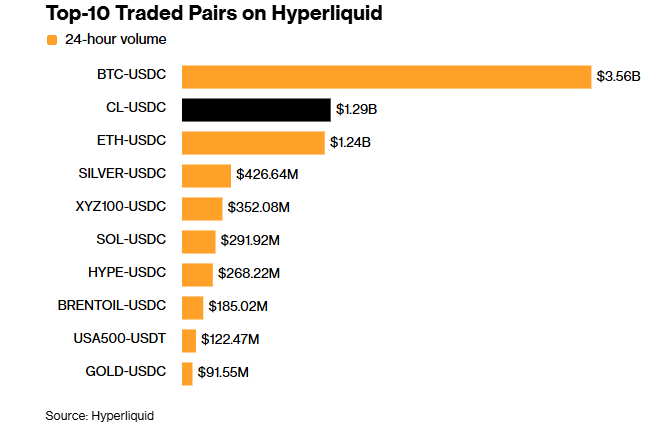
That episode highlighted the value of an infrastructure that allows operate 24 hours a day, seven days a weekwithout depending on the schedules of traditional stock exchanges.
On March 18, S&P Dow Jones licensed the S&P 500 index to the Trade platform[XYZ] to operate perpetual contracts within the Hyperliquid network. This is a relevant milestone, as it is the first time that an institutional benchmark of this type is integrated into a digital asset environment through perpetual derivatives.
It should be noted that, through contracts, investors can take upward or downward positions with leverage, without expiration date and without schedule interruptions, which eliminates the limitations of traditional markets.
This type of integration reinforces the narrative of convergence between traditional finance and digital environments, at a time when global volatility, including geopolitical tensions, is leading investors to explore new alternatives.
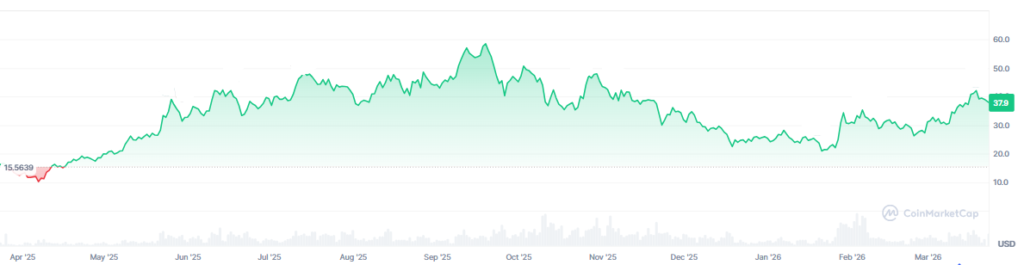
In this context, the network’s native token, hype (HYPE), has accompanied the growth. In the last 12 months it registers an increase close to 140%reflecting the increase in activity within the ecosystem.
Canton Network: infrastructure for financial institutions
As NoticiasVE has reported, it is a network designed specifically for financial institutions, aimed at the issuance, management and settlement of tokenized assets.
Unlike open networks, Canton operates under a private governance model, where the participants, banks, technology companies and financial entities, define the operating rules. Among its promoters are companies such as Microsoft, Goldman Sachs, BNP Paribas and Deutsche Börse.
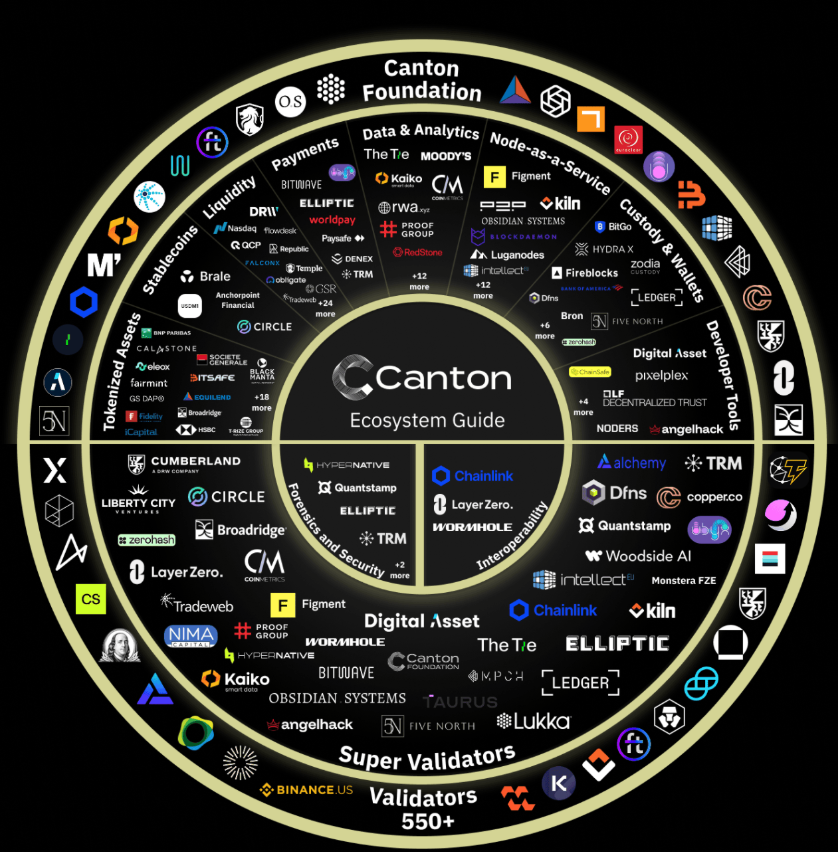
Their proposal focuses on interoperability and privacy. Each participant maintains its own ledger, while a synchronization layer allows transactions to be executed in a secure and coordinated manner.
One of the most relevant developments was the incorporation of Nasdaq as a “super validator”. This role involves advanced functions within the network, combining validation, participation in governance and technical operation.
In Canton, a super validator does not fulfill the same role as a public network validator. In this case, it has more weight within the system, participating in the validation of the Canton Coin, in the coordination of the consensus and in certain governance processes through the Global Synchronizer.
At the time of publishing this article, the network has 826 active validators and more than 13 super validators.
The difference is that validators process the transactions assigned to them and act as an entry point for applications and assets. Super validators, for their part, fulfill a broader role: they participate in the global validation of network transfers, coordinate consensus and facilitate communication between nodes. They also intervene in governance processes within the network.
Still, Canton is not a completely open network. The entry of new validators and applications requires sponsorship and prior approval, so combines operational decentralization with controlled access, designed for regulated institutions.
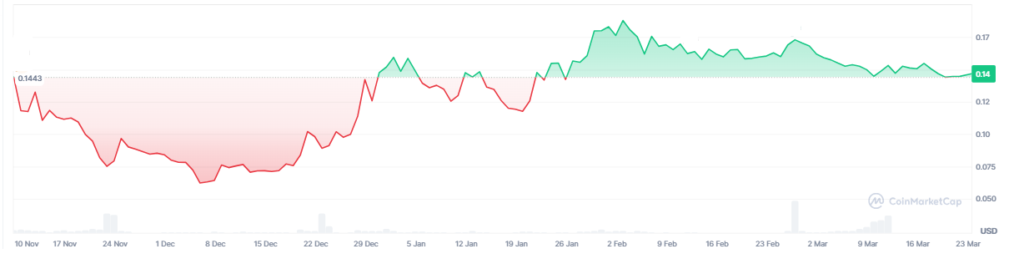
The network token, canton coin (CC), was launched on the market in November 2025. At the time of publication of this article, March 23, 2026, it is up 23%:
River: DeFi, interoperability and strong market growth
River is the project that has stood out the most recently in terms of performance. Your river token (RIVER) It is currently one of the best performing assets within the top 100 by capitalization in the last 12 months. Its growth reaches approximately 689%.
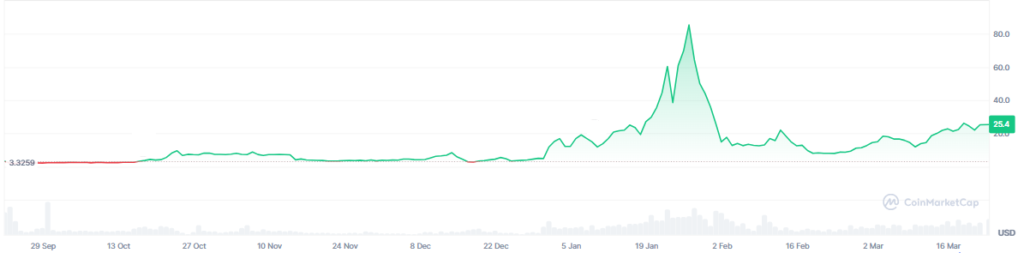
River is a DeFi protocol that operates on Ethereum and is designed to connect liquidity between different networks. Among them Tron, BNB Chain, Base and Arbitrum.
Its operation is based on a collateralization system. Users can deposit assets as collateral to issue the satUSD stablecoin, which can then be used in various digital environments to generate yield or provide liquidity.
Among the main recent catalysts is an airdrop held in February, where 250,000 tokens were distributed to early users. These types of events It usually stimulates demand, especially in a bull market context.
Added to this are high returns in liquidity pools within PancakeSwap, where currently the estimated annual rate stands at 317.86% APR (Annual Percentage Rate) up to 340%. This level of return attracts capital and reduces the circulating supply available for sale, by incentivizing users to keep their tokens locked to generate yield.
The market evolves beyond price
The advancement of Hyperliquid, Canton Network and River reflects a broader transformation within the ecosystem.
Far from focusing solely on speculation, the market shows a trend towards infrastructure developmentintegration with the financial system and more complex solutions for different user profiles.
This change in focus occurs in an environment where global liquidity, regulation and geopolitical factors are beginning to have increasing weight. A situation that forces projects to differentiate not only because of its technologybut for their ability to adapt and solve real problems.