
The horizon of bitcoin (BTC) begins to be defined under the lens of institutional methodology. While the global financial ecosystem seeks safe harbors from monetary devaluation, CF Benchmarks has presented a projection of the price of bitcoin in 10 years.
The firm establishes that bitcoin not only competes for a fraction of global capital, but is positioned as an essential component for the efficiency of investment portfolios through a framework that supports strategic and tactical investment horizons.
CF Benchmarks bases its projections on a comprehensive analysis system. This modeling framework supports long-term price target of $1.42 million per bitcoin by 2035«driven by the capture of approximately one third of the growing global market for value reserves, as seen in the following image.
At the same time, it projects that volatility will continue its structural decline, falling toward 28% over the next decade as liquidity increases, institutional participation expands, and derivatives markets mature.”
The architecture of this model is based on comparative valuation, the economics of production and the sensitivity of BTC to monetary devaluation.
According to the report, “this combination of high expected returns, moderate volatility, and persistently low correlations positions bitcoin as an attractive option for a multi-asset portfolio.”
Institutional surveys indicate—according to CF Benchmarks—that a large majority of investors believes in the long-term value of blockchain and digital assetsand a significant percentage plan to increase their allocations to cryptoassets and related products in the next two years.
The efficiency of the multi-asset portfolio
The research emphasizes that The inclusion of bitcoin in a diversified portfolio should not be seen as a speculative bet. The analysis becomes relevant after observing the behavior of the market, where bitcoin has just reached its historical maximum of $126,000 last October, as reported by NoticiasVE, consolidating its structural upward trend.
“Even with portfolio weights of 2 to 5%, bitcoin improves long-term risk-adjusted returns and expands the efficiency frontier.”
The applied methodology suggests that prudence is key in the institutional investment strategy. «The goal is not to risk everything, but to test whether a moderate allocation can improve long-term risk-adjusted results under reasonable assumptions.»
Regarding the size of the position within a fund, the firm points out that, at 5%, bitcoin «is large enough to be relevant in strong periods of rise, but small enough for declines to remain controllable within a multi-asset framework, especially with disciplined rebalancing.»
This structure allows capital managers to mitigate risks while exposing capital to BTC growth, as projected in the institutional scenario modeling below. The gold-based scenarios (orange and turquoise) are the most ambitious, as they position bitcoin as a direct competitor to gold as a store of value.
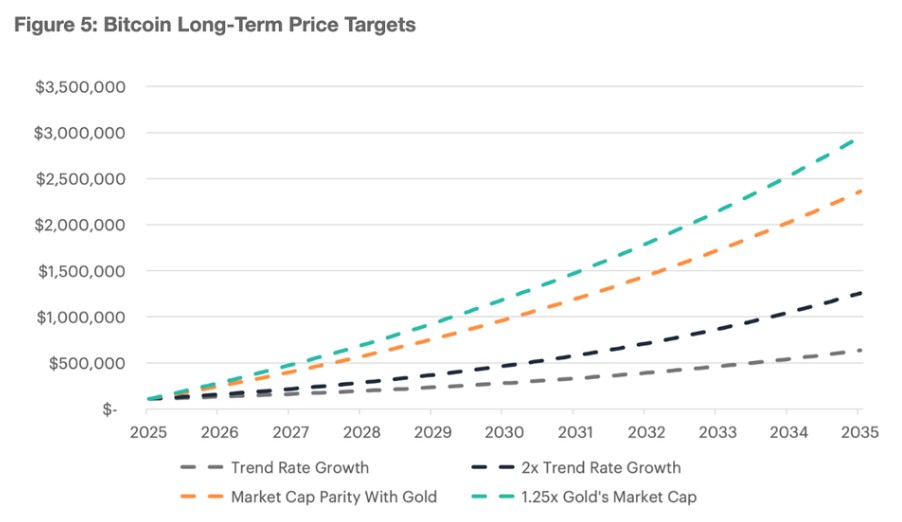
Price scenarios for bitcoin in 10 years
The report breaks down three possible scenarios for bitcoin valuation. The base case, mentioned earlier, sets a target of $1.42 million by 2035. This framework implies that bitcoin captures approximately 33% of gold’s market capitalization.
On the other hand, The bearish case places the price at $637,000 by 2035. In this context, the digital currency “captures store-of-value market share at its historical trend rate, reaching approximately 16% of gold market capitalization amid slower but sustained adoption.”
Finally, the bull case projects $2.95 million by 2035, a scenario where “bitcoin becomes the dominant global store of value, absorbing investment flows from gold and reaching approximately 125% of its market capitalization, driven by accelerated institutional and sovereign adoption.”
To understand the magnitude of these projections, it is essential to visualize the upward trajectory that the asset could follow under different adoption frameworks, as seen in the graph.
In all scenarios, strategic allocation improves efficiency. Says CF Benchmarks: «In our simulations, bitcoin’s high expected returns, decreased volatility, and low correlations with equities and bonds widened the efficient frontier, allowing higher return targets to be achieved at comparable or lower risk levels.»